Abington High School Environmental Science Press Release
In May, students from Abington High School’s Honors Environmental Science class conducted a study where they tested for Per- and Polyfluoroalkyl Substances (PFAS) in surface water bodies in Abington. PFAS were first manufactured during the late 1930s for the Manhattan Project to coat the inside of tanks, making them water resistant before sending them to war. In addition to being water repellant, PFAS are resistant to heat, grease, and staining. Upon seeing the usefulness, PFAS were incorporated into everyday household and industrial products, such as pans, food packaging, cosmetics, herbicides, and fire fighting foams. They seemed to be miracle chemicals, frequently called “forever chemicals” due to their extreme durability and “lifespan”. With everything that seems “too good to be true”, it left many wondering, “Was there a catch to this miracle?” It didn’t take all too long to see the detrimental effects this group of chemicals has on the health of living creatures, especially humans.
In research later released by the DuPont company, it was found that PFAS were directly linked to causing cancer and deformities and were poisoning company workers. In 2005, PFAS were linked to several types of cancer, liver damage to animals and people, and birth defects. PFAS were also discovered to be very destructive to the environment. PFOA and PFOS were banned in food contact products in the United States in November 2016. It has been learned that due to their heavy use, PFAS are widespread in the environment and can take 1000 years to break down.
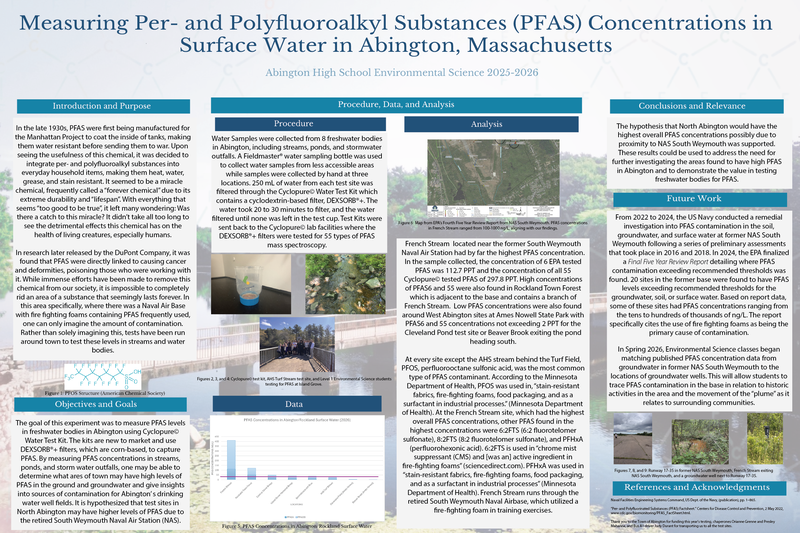
Using Cyclopure’s new water testing kits, AHS Environmental Science students collected water samples from 8 different locations in Abington, including streams, ponds, and stormwater outfalls, to test for 55 different kinds of PFAS. 6 of these kinds of PFAS are EPA regulated and have federal limits set for drinking water. Cyclopure’s test kits use DEXSORB®+ filters, which are corn-based, to capture PFAS. By measuring PFAS concentrations in streams, ponds, and stormwater outfalls, one may be able to determine what areas of town may have high levels of PFAS in the ground and groundwater. PFAS concentrations were measured in parts per trillion (PPT), which is equivalent to nanograms per liter. The kits are not approved to provide official data for government agencies or for official decision-making but have been shown to provide results close to those of state and federally approved lab tests.
Test sites near the former South Weymouth Naval Air Station had by far the highest PFAS concentrations for both the 6 and 55 kinds of PFAS tested. One of these test sites was along French Stream, which had PFAS concentration of 112.7 PPT for PFAS6 and 297.8 PPT for PFAS55. Low PFAS concentrations were found around West Abington sites at Cleveland Pond and Beaver Brook where PFAS6 and 55 concentrations did not exceed 2.1 PPT.
The results of PFAS concentrations being high in North Abington were expected because of the close in proximity to former NAS South Weymouth. From 2022 to 2024, the US Navy conducted a remedial investigation into PFAS contamination in the soil, groundwater, and surface water at former NAS South Weymouth following a series of preliminary assessments that took place in 2016 and 2018. In 2024, the EPA finalized a Five-Year Review Report where 20 sites in the former base were found to have PFAS levels exceeding the recommended thresholds for soil, groundwater, or surface water. The report specifically cites the use of fire fighting foams as being a primary cause of contamination.
While the results of our study cannot be used to inform policy decisions, they could be used to support the need for further investigating the areas found to have high PFAS in Abington and to demonstrate the value in testing surface water for PFAS.